POST [SOV]
A [SPATIAL] MANIFESTO FOR
[COLLAB]ORATION AND [ADAPT]ATION IN
ANTARCTICA
Antarctica, the southernmost continent, is governed by the UN’s Antarctic Treaty of 1959, which designates it as a place for peaceful purposes and scientific and environmental collaboration (Secretariat of the Antarctic Treaty 1959). When observed through a [SPATIAL] perspective, two persistent problems emerge, deep rooted in the continent’s [POST] sovereign existence. Firstly, the research stations in Antarctica operate largely in isolation, with their own energy footprints, their own infrastructural frameworks and their own supply chains. Secondly, rising uncertainty such as geopolitical tensions, climate change, tourism growth, and resource speculations increase strain on the [SPATIAL] organization of presence on the continent. Thus, this research intends toaddress these two intertwined [SPATIAL] challenges: fragmentation, via [COLLAB]oration, and uncertainty, via [ADAPT]ation.
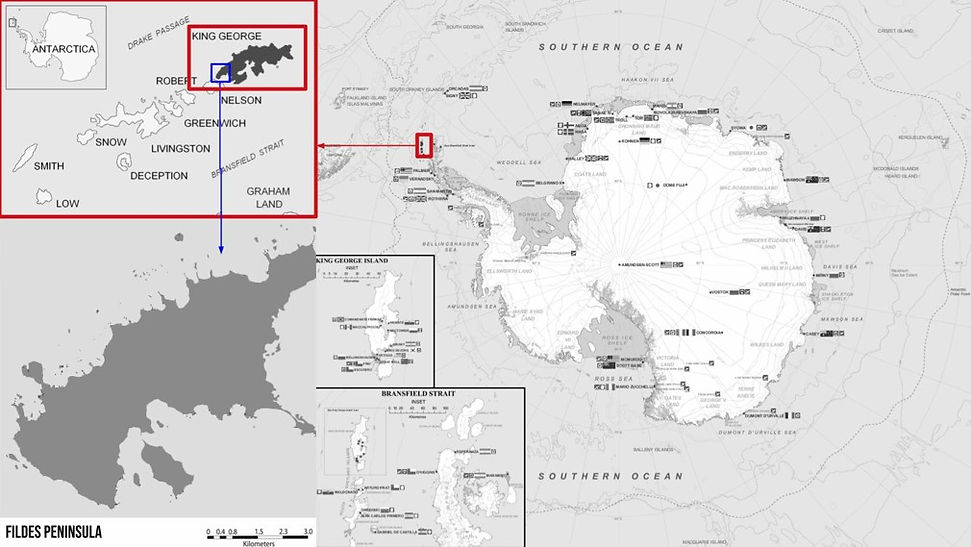
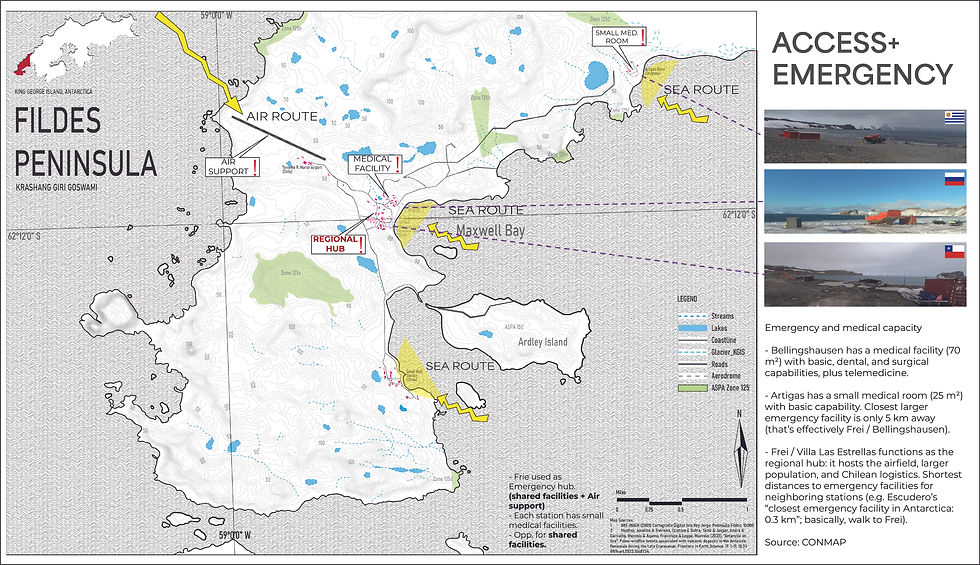
Scenario Planning provides a structured framework to address uncertainty, while fostering [COLLAB]oration among actors (Goodspeed 2020). Instead of predicting one single future, it has the ability to test decisions across multiple plausible futures and reveal where collaboration becomes necessary or strained. This research applies four established Antarctic scenarios from the existing scholarship to the Fildes Peninsula on King George Island, which is one of the most [SPATIAL]ly dense and politically layered regions of the continent. Using a structured evaluation framework, each scenario is translated into spatial indicators and are then tested to assess their [COLLAB]orative and [ADAPT]ive capabilities.
In parallel, the research explores modular architecture as a [SPATIAL] instrument for [COLLAB]oration and [ADAPT]ation. Modular systems are not new to Antarctica, as they have demonstrated potential for resilient construction and transport processes. The idea here is to test their deployment in the Fildes Peninsula using ready-to-deploy modules, which can be attached to a shared infrastructural spine connecting the Chilean Frei Station and the Chinese Great Wall Station, addressing the problem of isolation by enabling shared equity in logistics and environmental systems. The idea is to test this architectural component’s capacity to operate as both connective tissue and an [ADAPT]ive mechanism.
Together, Scenario planning and modular architecture form a coupled planning-design methodology, where scenarios analyze where cooperation is [SPATIAL]ly required and where stress fractures may emerge, while the modular systems can provide the physical means to respond to these plausible futures.
Combined M.Arch. + M.RP. Dual-Degree Thesis
Project Team
Krashang Giri Goswami
Thesis Chairs
Thesis Committee Advisors